Support our educational content for free when you purchase through links on our site. Learn more
What Classroom Supplies Does Discount School Supply Carry? 🧰

What types of learning materials and supplies does Discount School Supply carry for classrooms? The retailer’s catalog spans arts and crafts, educational toys and manipulatives, STEM and sensory-play materials, dramatic-play props, classroom furniture and storage, early-childhood resources, outdoor play equipment, and everyday teacher supplies.
That breadth is handy when one classroom needs paint, a building challenge, and somewhere to put both. We’ve seen a simple set of manipulatives turn into a counting activity, a pretend shop, and a lively debate about who gets to be the customer—proof that versatile materials can earn their shelf space.
Key Takeaways
- Creative supplies: Explore art and craft materials for projects, process art, and classroom creativity.
- Hands-on learning: Look for educational toys, manipulatives, STEM materials, and sensory-play resources.
- Classroom setup: Browse furniture, storage, early-childhood supplies, outdoor-play equipment, and everyday essentials.
- Choose thoughtfully: Check each product’s age guidance, dimensions, safety information, cleaning needs, and current availability.
- Plan around learning goals: Versatile, well-organized materials can support multiple activities without turning your classroom into a supply avalanche.
Table of Contents
- ⚡️ Quick Tips and Facts
- 🏫 Discount School Supply: Background and Classroom Focus
- 🧰 What Types of Classroom Learning Materials and Supplies Does Discount School Supply Carry?
- 1. Arts and Crafts Supplies for Creative Classrooms
- 2. Educational Toys, Games, and Learning Manipulatives
- 3. STEM, Science, and Hands-On Discovery Materials
- 4. Sensory Play and Fine Motor Skill Supplies
- 5. Dramatic Play and Pretend-Play Props
- 6. Classroom Furniture, Storage, and Organization
- 7. Early Childhood and Preschool Learning Resources
- 8. Outdoor Learning and Active Play Equipment
- 9. Books, Literacy, and Classroom Communication Materials
- 10. Everyday Classroom Essentials and Teacher Supplies
- 🎯 Supplies by Age Group, Grade, and Learning Need
- 🧠 How Classroom Materials Support Learning and Development
- 🎨 Classroom Activities and Project Ideas Using Discount School Supply Materials
- Art, Craft, and Process-Based Projects
- STEM Challenges and Science Investigations
- Sensory Stations and Fine Motor Activities
- Dramatic Play and Cross-Curricular Learning
- Outdoor Exploration and Movement Activities
- 🏷️ Brands and Product Lines to Explore
- 🛒 How to Choose the Right Classroom Supplies
- Check Age Recommendations, Safety, and Durability
- Match Materials to Learning Goals and Classroom Space
- Plan for Storage, Cleaning, and Reuse
- ✅ Benefits and ❌ Trade-Offs of Shopping for Classroom Materials Online
- 💡 Tips for Organizing and Getting More from Your Supplies
- 👩 🏫 Who Can Benefit from Discount School Supply?
- 🔎 Finding Supplies by Subject, Classroom Need, and Brand
- Conclusion
- Recommended Links
- FAQ
- Reference Links
⚡️ Quick Tips and Facts
If you’re trying to reach Discount School Supply directly, our guide on how to contact Discount School Supply can help. For classroom essentials beyond one retailer, browse our classroom supplies and early childhood education supplies categories.
Discount School Supply is a broad school-suplies retailer, not just a shop for crayons and construction paper. Its catalog is organized around arts and crafts, play and learning, early childhood, furniture, classroom essentials, and outdoor play. Specific products and availability can change, so check the current Discount School Supply categories before planning a classroom order.
| At a glance | What to know |
|---|---|
| Common classroom needs | Art materials, educational toys, manipulatives, sensory-play supplies, furniture, storage, and everyday essentials |
| Strongest audience | Preschool, early-childhood, elementary, childcare, and other learning settings |
| Useful shopping approach | Shop by classroom goal, age group, and space—not just by product name |
| Before ordering | Verify current product details, age guidance, material information, delivery restrictions, and return terms |
| Best teacher move | Pair open-ended materials with a clear learning goal, then let students do the interesting work |
Teacher tip: A box of loose parts can support sorting, storytelling, counting, pattern-making, and collaborative play. The trick is not buying every shiny object in the catalog; it’s choosing materials your students can use in more than one way. We’ll get to practical ways to do that below.
🏫 Discount School Supply: Background and Classroom Focus

Discount School Supply serves educators and learning environments with supplies spanning creative projects, play-based learning, classroom setup, and more. The site’s breadth can be useful when you’re sourcing for several classroom needs at once, but it also means the catalog is best approached with a plan.
A note about source verification: the supplied summaries of Discount School Supply’s playground equipment and cognitive development and fine motor category pages contained hidden HTML fragments rather than readable product descriptions. That means those summaries don’t substantiate particular products, brands, ratings, or specifications. We’ll describe the retailer’s broad shopping categories without pretending a page verifies details it doesn’t show. Check current listings for product-level information.
It’s also useful to distinguish retailers when comparing options. For example, the supplied Lakeshore Learning summary describes Lakeshore Rewards terms, not Discount School Supply’s inventory. It notes selected membership perks and shipping exclusions, but those details should not be treated as Discount School Supply policies. Always check each retailer’s own current terms.
🧰 What Types of Classroom Learning Materials and Supplies Does Discount School Supply Carry?
Discount School Supply groups products across several classroom-use areas. The categories below are useful starting points; an individual item’s current availability, age range, and specifications should be confirmed on its listing.
1. Arts and Crafts Supplies for Creative Classrooms
Art materials help students experiment with color, texture, shape, and construction. Look for classroom supplies such as:
- Paper, drawing materials, and craft basics
- Paint and painting tools
- Modeling and sculpting materials
- Collage, decorating, and project materials
- Tools for group or process-art activities
For young students, large, easy-to-handle materials can make participation less fiddly. For a mixed-age group, set out several ways to approach one prompt: draw it, build it, paint it, or tell a story about it. That’s how one project becomes a dozen original ideas instead of twenty identical paper suns.
Review the product listing for material details and age guidance. For safety context, the U.S. Consumer Product Safety Commission’s art and craft safety information is a helpful reference.
2. Educational Toys, Games, and Learning Manipulatives
Manipulatives are objects students can move, group, compare, or arrange while learning. Depending on current catalog availability, teachers may look for:
- Counting and sorting materials
- Matching and sequencing games
- Building and construction toys
- Puzzles and tabletop activities
- Pretend-play sets and classroom games
These materials can give abstract ideas a physical foothold. A child who struggles to picture “five more” may understand it faster when they can actually add five counters. The National Council of Teachers of Mathematics provides resources on effective mathematics teaching, including the role of representations and mathematical tools.
What to check: piece count, storage needs, durability, age suitability, and whether the set supports individual, partner, or small-group use.
3. STEM, Science, and Hands-On Discovery Materials
STEM learning materials encourage students to ask questions, test ideas, build, observe, and revise. Depending on the product range, classroom shoppers may explore:
- Building and engineering materials
- Basic science and observation tools
- Nature-study resources
- Early math and pattern materials
- Open-ended objects for design challenges
A simple classroom challenge can be more valuable than a complicated kit: “Can you build a bridge that holds three toy animals?” Students make a prediction, test a structure, notice what failed, and try again. That’s engineering with a paper cup and a surprisingly serious committee meeting.
For broader guidance on science learning, see the National Science Teaching Association. Before buying a kit, check whether it includes all required components, whether materials are reusable, and whether adult supervision is recommended.
4. Sensory Play and Fine Motor Skill Supplies
Sensory and fine motor materials support exploration through touch, movement, and hands-on manipulation. Examples in this broad category may include:
- Sensory-play materials and accessories
- Tools for squeezing, scoping, pouring, or pinching
- Lacing, threading, and construction activities
- Materials for hand-strength and coordination practice
- Early-learning toys designed for exploration
Fine motor practice is most engaging when it feels like play rather than a worksheet wearing a disguise. Try adding scops and cups to a supervised sensory station, or offer construction pieces that require students to connect, twist, or place components.
Always check age labels and choking-hazard warnings, especially for small parts. The U.S. Consumer Product Safety Commission’s toy safety guidance offers useful general information. For current category browsing, see Discount School Supply’s cognitive development and fine motor section.
5. Dramatic Play and Pretend-Play Props
Pretend play gives children a chance to rehearse language, social roles, and everyday problem-solving. Depending on what’s currently listed, teachers might look for:
- Role-play props and accessories
- Play food and community-themed materials
- Dress-up items
- Props for a pretend shop, clinic, home, or post office
One educator on our team once watched a pretend café become a spontaneous math lesson: students made menus, counted pretend orders, and negotiated who was “on break.” The lesson plan had not budgeted for employee management, but the learning was unmistakable.
Use dramatic-play materials with open-ended prompts. Ask, “What does your shop need today?” rather than assigning every child a fixed role. The National Association for the Education of Young Children shares resources on play in early learning.
6. Classroom Furniture, Storage, and Organization
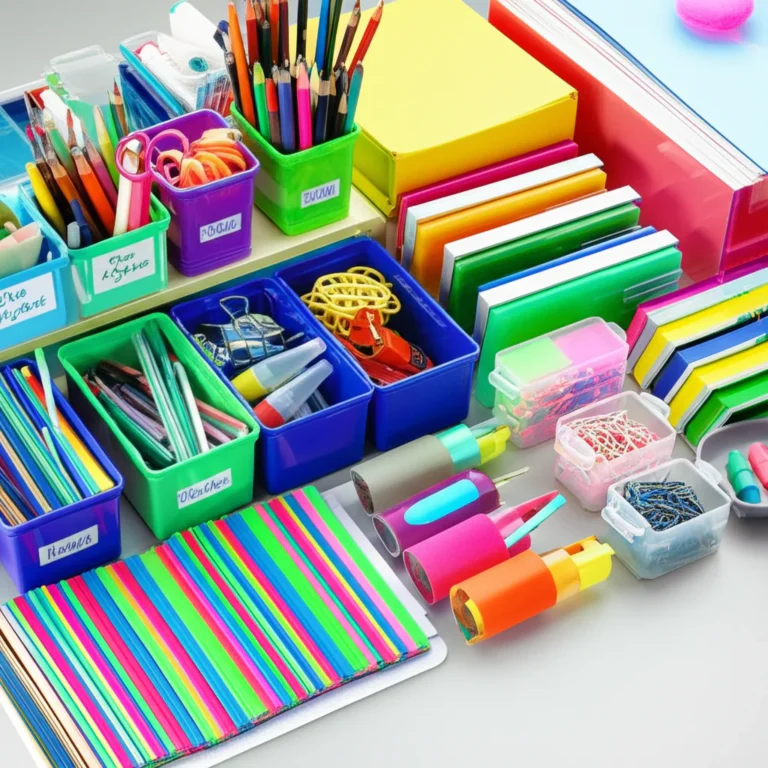
A classroom can have wonderful materials and still feel like a supply closet after a small tornado. Furniture and storage products can help create clear activity zones and make materials easier to access.
Common shopping needs include:
- Tables and seating
- Shelving and storage units
- Bins, organizers, and classroom containers
- Activity-area furnishings
- Displays and room-organization products
Before selecting furniture, measure doorways, room layout, and available floor space. Confirm dimensions, assembly requirements, weight limits, and delivery details on each listing. For larger or heavy items, shipping and delivery rules may differ from those for small supplies; check the retailer’s current policy rather than assuming standard parcel delivery applies.
7. Early Childhood and Preschool Learning Resources
Early childhood classrooms often need materials that are approachable, durable, and flexible across developmental stages. Browse the retailer’s early learning and infant-toddler categories for age-relevant options.
When choosing materials for preschool or childcare settings, consider:
- Age recommendations and supervision needs
- Size of pieces and potential choking hazards
- How easily items can be cleaned
- Whether children can use them independently
- Whether the activity invites exploration rather than one “right” result
Our early childhood education supplies category is another place to explore classroom-planning ideas.
8. Outdoor Learning and Active Play Equipment
Outdoor materials can help teachers create opportunities for movement, nature observation, imaginative play, and large-motor activity. Discount School Supply has a playground equipment category, though product details should be verified on the live listings.
Before choosing outdoor equipment, consider:
| Check | Why it matters |
|---|---|
| Intended age group | Helps match equipment to students’ needs |
| Space and surface | Affects safe placement and supervision |
| Assembly and installation | Larger equipment may need extra planning |
| Weather exposure | Influences durability and storage |
| Supervision guidance | Helps staff plan safe use |
| Delivery restrictions | Bulky items may have different shipping arrangements |
For general playground safety recommendations, consult the U.S. Consumer Product Safety Commission’s public playground safety handbook. Follow the manufacturer’s instructions and local safety requirements for any equipment you select.
9. Books, Literacy, and Classroom Communication Materials
Literacy-rich classrooms surround students with opportunities to talk, listen, read, tell stories, and share ideas. Depending on the current catalog, educators may explore books and supporting materials alongside their classroom-learning supplies.
Useful classroom considerations include:
- Books that reflect students’ interests and experiences
- Materials for read-alouds and storytelling
- Visual supports and classroom communication tools
- Resources that connect literacy to dramatic play and art
A basket of picture books beside a block area can prompt students to build a scene from a story. That pairing quietly connects reading, vocabulary, design, and teamwork.
10. Everyday Classroom Essentials and Teacher Supplies
Some classroom supplies are less glamorous than a giant cardboard castle—but they’re the reason the castle survives until Friday. Depending on the current assortment, everyday needs may include basic project materials, organization tools, and classroom-use essentials.
Make a quick supply inventory before ordering:
- Count what you already have. The mystery drawer may contain more glue sticks than anyone remembers.
- Separate recurring needs from one-time projects.
- Estimate how many students will use each item.
- Check whether supplies can be shared, reused, or replenished.
- Confirm product specifications and delivery expectations.
🎯 Supplies by Age Group, Grade, and Learning Need
A material that works beautifully in one classroom may be too small, too advanced, or simply too complicated for another. Use age and learning context as a filter, not an afterthought.
| Setting | Helpful material characteristics | Planning considerations |
|---|---|---|
| Infant and toddler programs | Large, sturdy, easy-to-explore materials | Age guidance, cleaning, supervision, and small-part warnings |
| Preschool | Open-ended art, pretend play, sensory exploration, and simple manipulatives | Independent access, storage, and flexible use |
| Kindergarten and early elementary | Early literacy, counting, building, and creative-project materials | Differentiation and small-group use |
| Upper elementary | More complex games, construction materials, and subject-linked projects | Challenge level, collaboration, and classroom durability |
| Childcare and community programs | Multi-purpose, easy-to-clean materials | High-frequency use and simple organization |
| Home learning | Compact, versatile supplies and clear directions | Storage, adult support, and reuse |
The Head Start Early Childhood Learning and Knowledge Center offers resources for early-learning settings. Use those resources alongside product-specific safety guidance, not as a substitute for it.
🧠 How Classroom Materials Support Learning and Development
Good classroom materials can support several skills at once. A construction set, for instance, may invite planning, spatial reasoning, fine motor practice, storytelling, and cooperation. The material doesn’t teach on its own, of course; the teacher’s environment, questions, and observation turn play into purposeful learning.
| Learning area | Materials that may support it | Teacher move |
|---|---|---|
| Early math | Counters, sorting objects, puzzles, blocks | Ask students to compare, group, count, and explain |
| Literacy and language | Books, puppets, dramatic-play props | Invite retelling, description, and new vocabulary |
| Science | Observation tools, nature materials, open-ended objects | Ask what students notice and what they predict |
| Fine motor | Art tools, lacing, connecting pieces, small manipulatives | Offer choices that encourage controlled hand movements |
| Social-emotional learning | Cooperative games and pretend-play materials | Help students negotiate roles and solve small conflicts |
| Creativity | Paint, collage, building materials, loose parts | Value experimentation over identical finished products |
For an evidence-informed overview of developmentally appropriate practice, see NAEYC’s guidance for early childhood educators. For early mathematics teaching resources, visit NCTM; for science education, see NSTA.
🎨 Classroom Activities and Project Ideas Using Discount School Supply Materials
The best activity often begins with a simple question—and a willingness to let students surprise you. Use current catalog items that fit your group, and check each product’s age and use guidance before setting up.
Art, Craft, and Process-Based Projects
Project: texture-and-pattern collage
- Offer a selection of paper and classroom-safe collage materials.
- Ask students to arrange materials into a repeated pattern or textured picture.
- Invite them to describe what they chose and why.
- Display the work with student explanations, not just the final product.
The learning lies in experimentation and description, not in making every project match the teacher’s sample.
STEM Challenges and Science Investigations
Project: build a shelter for a toy animal
- Present a small set of building materials.
- Ask students what the shelter needs to protect against.
- Have each student or group draw a plan.
- Build, test, and revise.
- Compare designs and talk about what changed.
This simple routine gives students practice with planning, observation, and revision. For classroom science ideas and teaching resources, consult NSTA.
Sensory Stations and Fine Motor Activities
Project: sort, scoop, and describe
- Choose age-appropriate materials and tools.
- Set up a supervised station with clear boundaries.
- Invite students to scoop, sort, transfer, or arrange objects.
- Add descriptive prompts: “Which feels rougher?” or “How many fit in your cup?”
- Clean and store materials according to the product guidance.
For toddlers and young children, check choking hazards carefully and select activities suited to your setting.
Dramatic Play and Cross-Curricular Learning
Project: classroom farmers’ market
- Arrange pretend produce and baskets.
- Add simple signs and picture-based labels.
- Invite students to take turns as shopper, seller, and organizer.
- Introduce counting, sorting, conversation, and early writing naturally.
As one teacher on our team likes to say, “If they’re arguing about whose turn it is to run the carrot stand, at least they’re using their words.” We still help them work it out, naturally.
Outdoor Exploration and Movement Activities
Project: noticing walk
- Agree on safe boundaries and supervision roles.
- Give students a simple prompt: find something smooth, something green, or something that makes a sound.
- Let students record observations through drawing, conversation, or classroom materials.
- Follow up indoors with a sorting, storytelling, or art activity.
For equipment-based activities, follow manufacturer instructions and safety guidance, including the CPSC playground safety handbook.
🏷️ Brands and Product Lines to Explore
Retailer catalogs and brand availability can change. When you see a brand or product on Discount School Supply, verify that the listing is current and check its specifications rather than relying on a familiar name alone.
A brand can tell you who made an item, but it doesn’t answer every classroom question. Confirm:
- Intended age range
- Materials and dimensions
- Cleaning instructions
- Whether batteries or accessories are included
- Warranty or replacement information
- Safety warnings and certifications, where applicable
For a wider view of learning materials, browse Discount School Supply’s current catalog and our classroom supplies collection.
🛒 How to Choose the Right Classroom Supplies
Check Age Recommendations, Safety, and Durability
Start with the item’s listed age range and warnings. Then consider how many students will use it and how often. A delicate craft material might work well for a supervised project but struggle through daily center time with a large group.
Look for clear product details and follow relevant safety guidance from the CPSC. If details are missing or unclear, contact the retailer or manufacturer before purchasing.
Match Materials to Learning Goals and Classroom Space
Use this quick planning sequence:
- Name the learning goal. Are students practicing counting, storytelling, building, or creative expression?
- Choose the format. Will the activity be individual, partner-based, or small-group?
- Measure the space. Include storage and student movement, not just the activity surface.
- Check the setup. Consider adult supervision, access, and cleanup.
- Plan a second use. Versatile supplies often earn their shelf space.
If the learning goal is “explore patterns,” you may need fewer materials than you think. A handful of objects and a good question can outperform a cart full of unrelated supplies.
Plan for Storage, Cleaning, and Reuse
Before ordering, ask:
- Where will materials live when they’re not in use?
- Can students safely reach and return them?
- Can the items be cleaned using your setting’s normal procedures?
- Are replacement pieces available?
- Will the material work in more than one activity?
Furniture and large items deserve an additional check for dimensions, assembly, delivery access, and any special shipping restrictions.
✅ Benefits and ❌ Trade-Offs of Shopping for Classroom Materials Online
| Potential benefit ✅ | Possible trade-off ❌ | How to plan around it |
|---|---|---|
| Browse many types of classroom supplies in one place | Large catalogs can feel overwhelming | Search by learning goal or category |
| Compare product information before choosing | Photos may not convey size or texture well | Check dimensions, materials, and reviews where available |
| Order for a classroom or program | Delivery needs can vary by product | Confirm shipping and delivery terms |
| Find options for different learning areas | Availability may change | Verify current listings before budgeting |
| Shop beyond local store selection | You can’t handle an item in person | Ask for details when listings are unclear |
About reviews: Read customer feedback as one perspective, not a guarantee. Look for repeated, specific comments about durability, ease of cleaning, missing parts, or classroom fit. A single glowing review that says “great!” is less useful than one explaining how a product held up with a group of preschoolers.
💡 Tips for Organizing and Getting More from Your Supplies
- Group by activity, not just by product type. A ready-to-use building bin saves setup time.
- Label shelves with pictures and words. Visual labels can help young students return materials independently.
- Introduce one new material at a time. Students can learn how to use it before the next exciting object arrives.
- Rotate open-ended materials. A smaller selection can invite deeper play and simpler cleanup.
- Keep a restock list. Note what gets used, what breaks, and what sits untouched.
- Store safety information nearby. Keep age guidance and cleaning instructions accessible to staff.
A practical classroom test: if students can’t find it, use it, and put it away with reasonable independence, the supply may need a better home—or a simpler setup.
👩 🏫 Who Can Benefit from Discount School Supply?
The range of classroom-use categories can be relevant to:
- Preschool and early-childhood educators
- Elementary teachers
- Childcare centers and early-learning programs
- School administrators and purchasing teams
- Libraries and community learning spaces
- Families supporting supervised home learning
Needs vary by setting. A childcare center may prioritize repeat-use durability and easy cleaning; an art teacher may need project materials in quantity; a family may value compact supplies that can be stored between activities. Choose for the learners and the space you have, not an imagined classroom with infinite cupboards.
🔎 Finding Supplies by Subject, Classroom Need, and Brand
A useful browsing route is:
- Start at the Discount School Supply all-categories page.
- Choose a broad area such as play and learn, arts and crafts, furniture, or outdoor equipment.
- Narrow the search by age group or classroom purpose if those filters are available.
- Open the product listing and verify specifications, safety notes, availability, and delivery information.
- Compare the item with your learning goal and storage plan before placing an order.
For category-level inspiration beyond one store, explore Teacher Supply Store’s classroom supplies and early childhood education supplies.